


In diabetes care, timely intervention and management always matter. During pregnancy, time plays an especially significant role.
Pregnancy compresses clinical decisions into a window measured in weeks, and glucose patterns can shift quickly. For people entering pregnancy with Type 1 or Type 2 diabetes, management often begins before conception. For those diagnosed with gestational diabetes (GDM), pregnancy is already well underway when a new monitoring and treatment routine begins.
Care teams have limited time to identify changing patterns, adjust the care plan and coordinate across specialties. Yet many workflows still depend on paper logs, portal photos or spreadsheets sent through the EHR every week or two. Before clinicians can act, they may first have to reconstruct the story.
A diagnosis that takes an emotional toll
Gestational diabetes diagnoses often happen early in the third trimester. Until that moment, a patient may have been focused on prenatal appointments, the baby’s development, and preparing for a new child at home. Suddenly, each meal becomes a clinical decision, and every glucose reading can shape the next several hours.
The work is both practical and emotional, and includes obtaining supplies, pricking a finger several times a day or getting used to a new CGM, timing checks around meals, recording each value, anticipating the next test and worrying that one number means something is wrong.
Even within our team at Glooko, we have heard several stories of these lived experiences within the past few years. Amy Dominicci, a member of the Glooko marketing team, was diagnosed with gestational diabetes during her second pregnancy and required insulin. She tested four times a day and recorded the results in a paper log. Repeated every day while managing a pregnancy and the rest of life, those tasks became a substantial burden.

Amy’s experience captures an important truth: monitoring becomes part of nearly every decision. Did I eat the right thing? Can I take this meeting before I test? Was that value high because of breakfast, stress, poor sleep or something changing in the pregnancy? There is rarely a completely passive day.
The patient often becomes the integration layer
Julia Fuller, also on our marketing team, experienced gestational diabetes during both of her pregnancies. Her first was managed through diet; during her second, she required insulin. Her care centered on biweekly discussions with a dietitian and diabetes educator, while she recorded her readings in spreadsheets and sent them through the EHR every two weeks between visits.
Both pregnancies became more medically complex. After her first delivery, Julia developed postpartum preeclampsia. During her second, she experienced recurring nighttime hypoglycemia and delivered at approximately 38 weeks after placental concerns emerged.

Amy’s paper logs and Julia’s spreadsheet were different versions of the same problem: the care team saw the pattern only after the patient delivered it. They were not only generating the data, but also organizing it, transporting it, and making sure it reached the right person – effectively becoming the integration layer for their own care.
Shared visibility for pregnant individuals and care teams
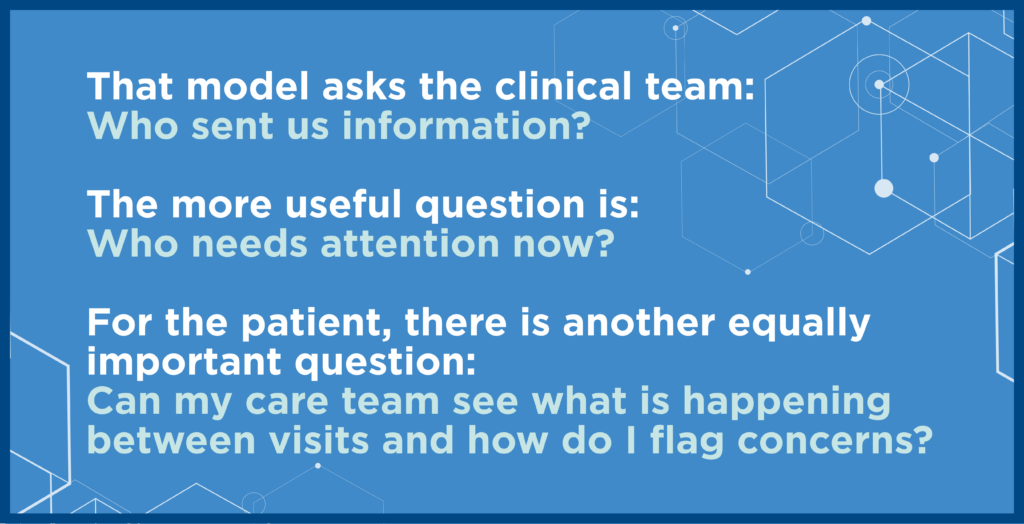
Clinicians experience the other side of this burden. Information may arrive in batches, in different formats, and without the context needed for efficient review. Across OB/GYN, maternal-fetal medicine, endocrinology, dietetics, diabetes education, and nursing, the information must remain coherent or the team has to reconstruct the story before deciding what to do.
Priority-based monitoring does not replace clinical judgment. It organizes available information so judgment can be efficiently applied to the right patients at the right time, surfacing which individuals may need attention, then supporting pregnancy-specific review of fasting and post-meal readings, low readings, missing data, and meal context.
For Amy, that could have meant making daily readings visible without carrying a paper record to the appointment. For Julia, it could have meant making nighttime lows visible between spreadsheet submissions. The goal is a clearer view that helps the patient and clinician understand the same story.
Between-visit care is still care
Scheduled visits remain essential, but glucose review, education, questions, and care plan reassessment can often occur between appointments, allowing digital tools to optimize in-person care rather than diminish its importance. Device syncing, mobile logging, meal context, educational resources, and secure communication can reduce manual burden while keeping patients connected to their care teams. That connection should continue after delivery by preserving pregnancy history and supporting an appropriate postpartum transition.
Moving from manual reporting to shared visibility
This is the thinking behind Glooko GestationalCare, the pregnancy-specific module within the GlookoCare outpatient diabetes platform. It is designed to help teams review their pregnancy population, identify patients who may need attention, understand fasting and post-meal patterns, engage patients between visits, and preserve continuity through postpartum transition.
For patients, supported mobile workflows can include device syncing, logging, meal tagging, goal tracking, education, and secure connection with the care team. For clinicians, the information can be organized into a pregnancy-specific workflow. GestationalCare supports GDM as well as Type 2 and Type 1 diabetes in pregnancy where approved, with capabilities varying by market and implementation.
Technology cannot remove the clinical uncertainty of diabetes in pregnancy or guarantee a different outcome. However, it can address care fragmentation or manual burden. Care teams should spend less time determining where to begin, and pregnant individuals should spend less time serving as the courier and organizer of their own data.
GestationalCare is now available to users in the United Kingdom and is expected to be available to customers in the United States by October 2026.
United Kingdom: Available Now!
Learn more or request a personalized pregnancy-workflow demonstration here.
United States:
Join the priority-access list here.